
Most of you know me as someone who spends a lot of time talking about markets, planning, and long-term thinking. But a few years ago, I had an experience that reminded me — in a very personal way — what uncertainty actually feels like. It was during early COVID.
At the time, there was so much unknown. Hospitals were overwhelmed, no one really understood how the virus spread, and the news cycle grew darker by the day.
Then something hit my health. For about a week I had a consistent fever between 101–103, along with coughing, chills, swollen glands, and no saliva. I was isolated in a bedroom and getting weaker by the day. Eventually it became clear that I needed help. The hospital was my next step.
I remember pulling into the parking lot and walking toward the entrance — and then turning around, going back to my car, and calling Val. In that moment, I honestly thought that going into the hospital might mean I wouldn’t see my family again. I was scared. Even now, thinking about that moment still makes me emotional.
 Eventually I went in. Because of COVID protocols, nothing felt normal. You had to wait outside, go through screening, and there was this strange feeling of isolation — almost like stepping into the unknown. After I was admitted and tested, I remember sitting alone in a room for nearly three hours before anyone came back in. My exact thought was:
What if this is the last thing I do?
It sounds dramatic now. Yet in that moment it didn’t feel dramatic at all. My body was weak. My mind was racing. And there was a quiet kind of fear that I had never really experienced before.
I ended up staying in that hospital for ten days. In the end, it wasn’t COVID. After what felt like endless testing, I recovered, walked out of the hospital on Day 10, slowly regained my strength, and life moved forward.
But that experience has stuck with me. It reminds me how powerful fear and uncertainty can be when you’re living through them, and how different things can look in hindsight.
The Feeling of Fear with Market Uncertainty
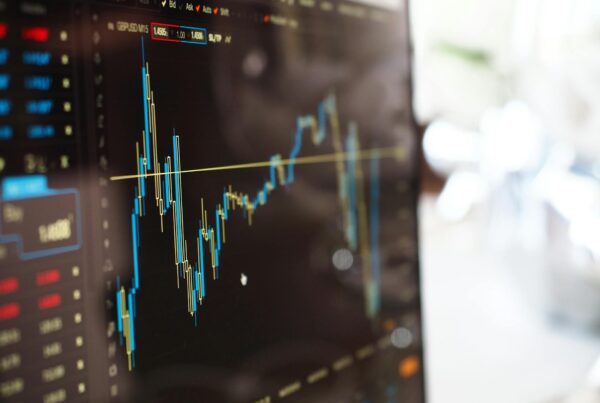
In markets, fear works the exact same way. When we look back at history, the big crises appear obvious and temporary. But when you are living through them, they feel permanent. This chart tells the story pretty clearly:
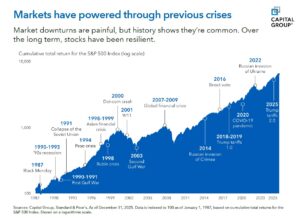 Over the last few decades, the market has endured:
- Black Monday (1987)
- Gulf Wars (1990-1991, 2003)
- Asian financial crisis (1998-1999)
- Dot-com crash (2000)
- 9/11 (2001)
- Global Financial Crisis (2007-2009)
- Brexit (2016)
- COVID pandemic
- Wars, inflation spikes, and trade conflicts
Each one felt enormous at the time. Each one made investors wonder: Is this time different?
And yet the long-term trend continued higher. Stocks pushed through every crisis and eventually reached new highs. In fact, if you had invested at the start of 2020 — knowing that a pandemic, inflation over 9%, wars, and massive geopolitical tension were coming — the market still would have risen more than 128% over the following years.
Think about that. If someone had told you in advance everything that was about to happen, you probably wouldn’t have invested a dollar. But markets kept moving forward anyway.
That’s the strange thing about both life and investing — progress rarely feels comfortable in real time.
Fear is loud.
Uncertainty is constant.
And the future always looks cloudy.
The Quiet Power of Endurance
But the things that matter most — health, relationships, careers, investments — usually grow slowly and quietly through discipline and endurance. Not through perfect timing. Not through avoiding every scary moment. But through staying the course when uncertainty feels the highest.
A Reminder (Mostly to Myself)
That day outside the hospital reminded me that fear is a natural human response to uncertainty. But it also reminded me that fear often fades faster than we expect.
Markets are the same way. The headlines always feel overwhelming in the moment, but history shows that resilience tends to win over time.
So when the next wave of uncertainty inevitably arrives — and it will — the goal isn’t to eliminate fear. The goal is simply to remember that uncertainty has always been part of the journey. And more often than not, the long-term rewards belong to those who endure it.